Evénements
Senegal
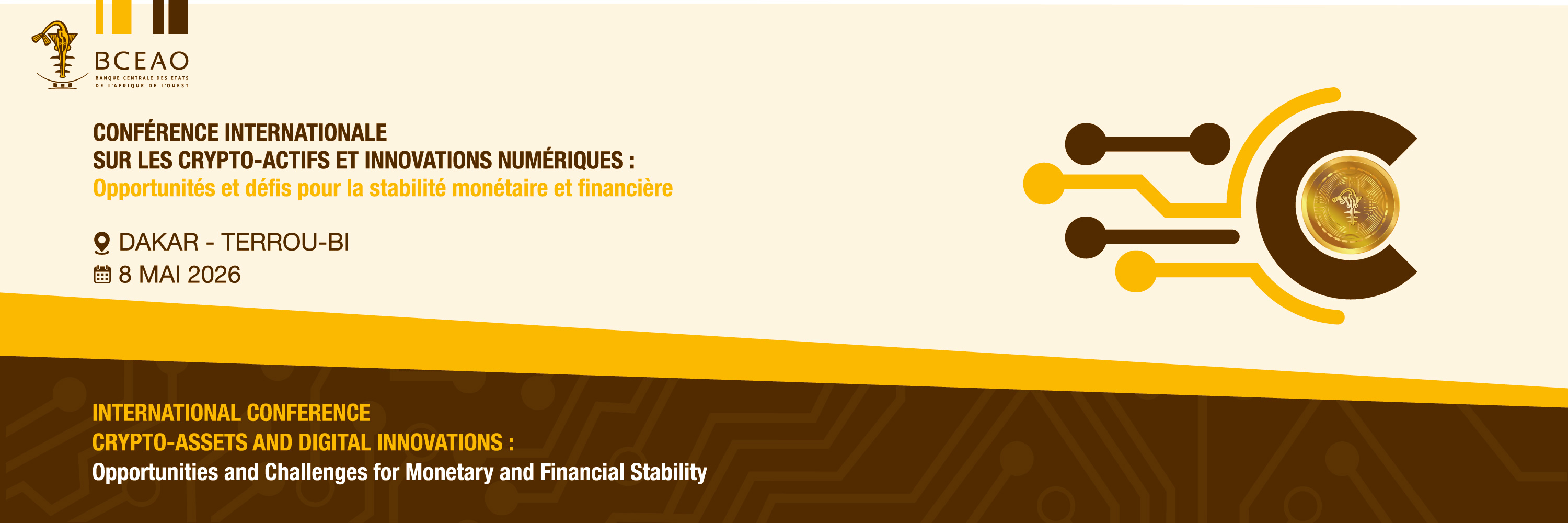
International conference on the theme of Crypto-assets and digital innovations : Opportunities and challenges for monetary and financial stability
View French version
 Follow the International Conference on Crypto-assets organised by the BCEAO live
Context and justification
The global financial landscape has been undergoing profound change driven by the development of digital technologies. The expansion of innovations such as crypto-assets, asset tokenisation1, particularly stablecoins2, and the emergence of Central Bank Digital Currencies (CBDCs) are transforming the way economic agents pay, save, invest and finance their activities. These developments promote greater transaction efficiency, diversification of financial instruments and improved adaptation of financial services to the needs of modern economies.
At the heart of this ecosystem, stablecoins, although representing only a relatively limited share of the total market capitalisation of the crypto-asset market, now account for the bulk of transaction flows, owing to their practical utility3. They offer significant advantages in terms of programmability, cost reduction and speed of transaction execution, thereby fostering broader access to financial services and enabling innovative digital solutions for cross-border payments.
However, these innovations raise critical challenges for financial stability and monetary governance. Indeed, the rapid expansion of digital assets entails a tangible risk of banking disintermediation and fragmentation of financial market infrastructures. This dynamic, further amplified by the intensification of cross-border flows, may undermine the effectiveness of monetary policy transmission mechanisms.
Nevertheless, the objective of monetary authorities is not to curb innovation, but rather to ensure its controlled and orderly integration, in order to reconcile the ongoing modernisation of the financial system with the preservation of its stability. In this regard, Central banks are called upon to strengthen their analytical capacities, deepen regional and international cooperation, and develop regulatory and supervisory frameworks that are adapted to emerging technologies.
At the international level, multilateral financial institutions and several African Central banks have stepped up their initiatives in the field of digital innovation :
- the International Monetary Fund (IMF) published a Handbook on CBDCs (2023)4 and has conducted several technical assistance missions, especially in sub-Saharan Africa, focusing on the design and regulation of digital currencies. The IMF has also issued practical guidance on the inclusive adoption of CBDCs and on the governance of digital transformation within financial systems ;
- the Bank for International Settlements (BIS), through its Innovation Hub, is leading numerous research and cooperation projects on CBDCs and tokenisation. Its survey report entitled "Central Bank Digital Currencies in Africa (2024)"5 highlights the progress of African initiatives in this field. The BIS has also recently published recommendations on crypto assets and stablecoins, as well as a review of regulatory frameworks governing crypto-asset activities6 ;
- the Central Bank of Nigeria (CBN) was a pioneer in Africa with the launch of the eNaira in 2021, the continent's first retail CBDC ;
- the Bank of Ghana (BoG) has been piloting the e-Cedi since 2022 with a view to enhancing financial inclusion and strengthening the security of domestic payments systems ;
- The South African Reserve Bank (SARB) is currently developing a wholesale CBDC project ;
- Bank Al-Maghrib (BAM) in Morocco is exploring the implementation of a national digital currency (e-dirham) to facilitate cross-border payments and reduce the costs associated with the issuance of coins and banknotes.
For its part, the Central Bank of West African States (BCEAO) has undertaken several initiatives aimed at promoting digital innovation while safeguarding the stability of the financial system. The include the establishment of a dedicated regulatory framework for payment services, the adoption of rules tailored to the development of electronic money, the launch of the Interoperable Instant Payment System Platform (PI-SPI), the creation of the Committee in charge of developing regulations on cryptocurrencies within the West African Monetary Union (C-CRYPTO) and the establishment of the Committee for Reflection on Artificial Intelligence (CRIA). In addition, reflections are ongoing on the advisability of issuing a central bank digital currency by the BCEAO. Together, these actions reflect the Central Bank’s commitment to supporting digital transformation within a secure, harmonised and resilient framework.
Overall, these various initiatives illustrate the determination of African central banks to adapt their prudential, regulatory, institutional and technological frameworks in order to preserve confidence and financial stability, while effectively harnessing the opportunities offered by financial innovation.
It is against this backdrop that the BCEAO plans to organise an international conference on the theme: "Crypto-assets and digital innovations: opportunities and challenges for monetary and financial stability". This high-level event will provide a platform for dialogue and experience sharing on technological and financial innovation policies, regulatory approaches and mechanisms for preventing emerging risks associated with digitalisation.
-----------------------------------------------
1. Asset tokenisation is a process that involves representing a real or financial asset (real estate, shares, bonds, works of art, commodities, etc.) in the form of digital tokens recorded on a distributed ledger technology, usually blockchain, facilitating ownership, exchange, traceability and fractionalisation.
2. Stablecoins are crypto assets that aim to maintain a stable value relative to a given asset or basket of assets.
3. TRM Labs – 2025 Crypto Adoption and Stablecoin Usage Report. The report highlights that stablecoins account for 30% of the total volume of crypto-asset transactions.
4. International Monetary Fund (IMF), Central Bank Digital Currency — Initial Considerations, Policy Paper No. 2023/048 (14 Nov. 2023), Washington, D.C.: IMF.https://doi.org/10.5089/9798400259210.007
5. https://www.bis.org/publ/bppdf/bispap159.pdf
6. Thematic Review on FSB Global Regulatory Framework for Crypto-asset Activities, Financial Stability Board, October 2025.
Objectives
The overall objective of the Conference is to strengthen understanding of the economic, monetary, prudential, regulatory and technological issues associated with the rise of digital innovations and crypto-assets. It will provide a high-level platform for discussion and analysis of their impact on African financial systems, with a view to identifying public policies and institutional arrangements that foster international cooperation and are necessary to preserve the stability and resilience of the financial sector in an evolving environment.
The Conference also aims to highlight the measures required to fully harness the opportunities offered by these innovations, while effectively managing the associated risks. More specifically, the Conference aims to :
- analyse the opportunities and risks arising from the expansion of crypto-assets and digital innovations for African economies, with an emphasis on their potential impact on the mandates and functions of African central banks ;
- share international experiences in the design, issuance and regulation of crypto-assets and central bank digital currencies ;
- examine the cybersecurity, governance and data protection mechanisms required to ensure the reliability and resilience of digital payment infrastructures in a context characterized by increasing technological and operational risks ;
- formulate strategic and operational recommendations based on strengthened regional and international cooperation, particularly in the area of supervision, given the cross-border nature of crypto-assets and digital innovations, with a view to developing a harmonised regulatory and institutional framework that reconciles the promotion of digital innovation and financial inclusion with the preservation of financial stability in the WAEMU area.
Expected results
The expected outcomes of this international conference are as follows:
- a better understanding of the dynamics of financial and technological innovation driven by the development of crypto-assets, central bank digital currencies and tokenisation mechanisms. In particular, participants are expected to gain a deeper insight into the implications of these developments for monetary policy, macro-financial stability, the structure of the banking and financial system, financial inclusion and the protection of users of innovative financial services;
- an overview of initiatives undertaken across the African continent in the areas of digital currencies, payment technology platforms and national regulatory frameworks for crypto-assets. This comparative perspective will help identify structural trends, institutional choices and lessons learned from different national experiences;
- the sharing of experiences and international best practices in regulation, supervision, technological governance, cybersecurity and data protection, drawing in particular on the strategic frameworks developed by the IMF, the BIS and several pioneering central banks;
- the formulation of strategic and operational recommendations to support the development of a harmonised regulatory framework within the WAEMU, with a view to effectively regulating financial innovation, maintaining public confidence, safeguarding the integrity of financial markets and strengthening financial stability;
- improved regional and international cooperation among monetary authorities, sectoral regulators, financial institutions and stakeholders in the digital economy.
Place and date
The conference will take place in Dakar on 8 May 2026 at Terrou-Bi Hotel.
Program